
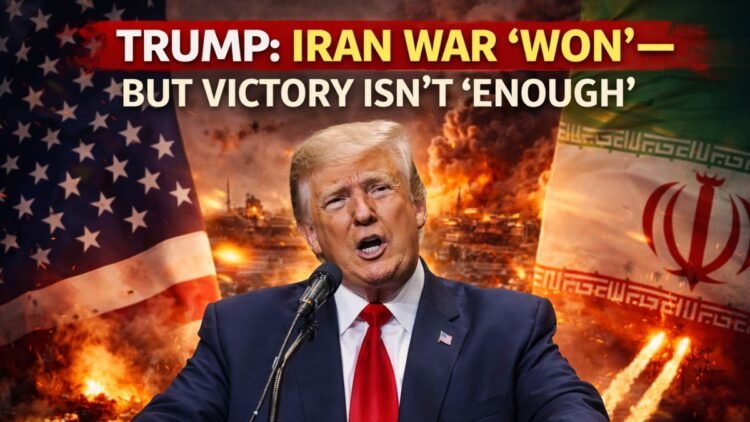
During a press conference in Doral, Florida, U.S. President Donald Trump delivered mixed and often contradictory remarks about the ongoing U.S. military intervention in Iran. Speaking at a critical moment for global politics and financial markets, Trump attempted to reassure allies and calm concerns about escalating tensions in the Middle East.
However, instead of offering a clear strategy for ending the conflict, his comments left many observers uncertain about the administration’s long-term objectives. At different points in the briefing, Trump described the war as “very complete” while also stating that U.S. operations would continue.

The remarks came as oil prices climbed above $100 per barrel, raising fears that the conflict could trigger wider economic instability and a deeper regional crisis.
“We Have Won, But Not Enough”
During the press conference and a separate speech to Republican supporters, Trump emphasized that U.S. forces had achieved major military successes against Iran.
He repeatedly suggested that the United States had “won in many ways”, highlighting the destruction of Iranian military infrastructure and strategic targets. Yet he also insisted that the victory was incomplete.

“We could call it a tremendous success right now,” Trump said, “or we could go further—and we’re going to go further.”
In one of the most widely discussed remarks, he declared: “We have won in many ways, but we haven’t won enough.”
This statement quickly sparked criticism from political opponents and analysts who argued that the administration has not clearly defined its objectives in the conflict.
Questions About the Endgame

Journalists pressed the president to clarify whether the war could end soon. Trump responded by suggesting that the conflict might wrap up “very soon,” though he stopped short of announcing a timeline for withdrawal or de-escalation.
When reporters pointed out the contradiction between his comments and statements from the defense secretary—who reportedly described the operation as “just the beginning”—Trump replied that both interpretations could be true.
He then suggested that the United States might play a role in “building a new country” in Iran. This statement appeared to conflict with earlier assurances from the administration that Washington would not pursue a nation-building effort similar to those attempted in Iraq and Afghanistan.
The shifting messages have left many observers uncertain about whether the administration intends to end the conflict quickly or expand its objectives.
Economic Concerns and Oil Market Impact
The conflict has also had immediate economic consequences. Global energy markets reacted strongly to the escalation, with oil prices surging above $100 per barrel on Monday.
To stabilize markets, Trump indicated that the United States might ease certain restrictions on international oil sales. This potential policy shift could reverse earlier efforts to tighten sanctions on Russian energy exports during the Ukraine conflict.
Trump suggested that these sanctions might not even be reintroduced if global stability improves. “Who knows,” he said, “maybe we won’t have to put them on again if there’s enough peace.”
Such comments raised questions among analysts about the consistency of U.S. economic policy during the crisis.
Controversial Claims About a Missile Strike
One of the most controversial moments of the press conference occurred when Trump discussed a deadly missile strike on a girls’ school in the Iranian city of Minab, which reportedly killed more than 168 people, most of them children.
Trump suggested that Iran might have obtained a Tomahawk cruise missile and used it in the attack. The claim immediately drew skepticism from reporters.
When asked whether the United States might bear responsibility—particularly because the strike occurred shortly before a nearby U.S. military operation—Trump responded that “many countries use Tomahawks.”
Pressed further about the source of the claim, the president acknowledged uncertainty, stating that the incident was still under investigation.
The exchange added to criticism that the administration was making serious allegations without presenting clear evidence.
Political Reactions
Trump’s remarks were quickly criticized by political opponents, who argued that the administration lacks a coherent strategy for the Iran conflict.
Senate Democratic leader Chuck Schumer described the press conference as evidence that the president could not clearly explain the nation’s war goals.
According to critics, the lack of a defined plan could increase the risk of prolonged conflict and economic disruption.
Supporters of the administration, however, argue that the president is keeping strategic options open while maintaining military pressure on Iran.
Conclusion
Trump’s latest statements on the Iran conflict have raised as many questions as they answered. While the president claims that the United States has already achieved major victories, he also insists that the mission is far from complete.
Without a clearly defined end goal or timeline, analysts and allies remain uncertain about how long the U.S. intervention will continue and what the final objective will be.
As tensions remain high and global markets react to the ongoing conflict, the world continues to watch closely for clearer signals from Washington about the future of the war.
FAQs
What did Donald Trump say about the Iran war?
Trump stated that the United States has “won in many ways” but also said the victory was “not enough” and that military operations could continue.
Why are oil prices rising during the conflict?
Oil prices surged above $100 per barrel because investors fear that the war could disrupt global energy supplies in the Middle East.
Has the United States announced when the Iran conflict will end?
No clear timeline has been announced. Trump suggested the conflict could end “soon,” but he did not provide specific details about a withdrawal or peace plan.