
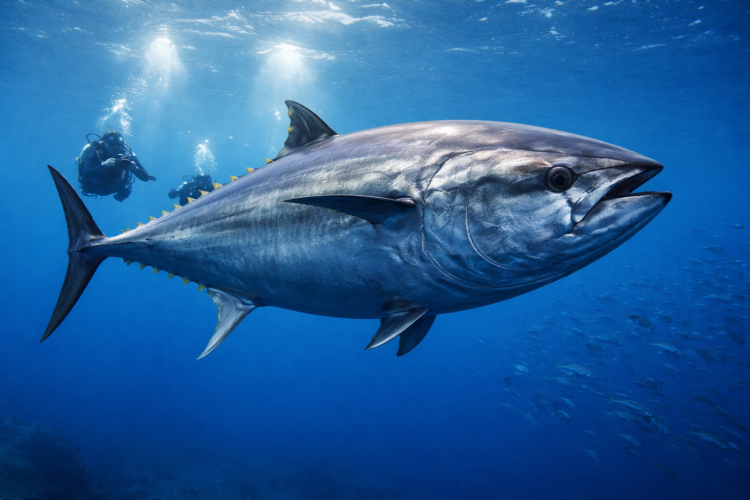
In early 2026, marine biologists confirmed a rare giant bluefin tuna specimen as one of the largest scientifically documented in recent years. This remarkable event has reignited both scientific interest and public fascination with one of the ocean’s most iconic species. Bluefin tuna are not only commercially valuable but also ecologically significant apex predators, capable of reaching staggering sizes and swimming vast distances across oceans.
The verification of such exceptional specimens underscores the importance of rigorous measurement protocols and accurate marine records to inform conservation, fisheries management, and scientific understanding of these migratory giants.
Scientific Importance Of Giant Bluefin Tuna

Bluefin tuna species such as the Atlantic bluefin (Thunnus thynnus) are amongst the largest fish in the world’s oceans. Mature individuals generally reach 2–2.5 meters in length and weigh 225–250 kg, though the largest recorded individuals can be much larger. Historically, the largest confirmed Atlantic bluefin tuna weighed nearly 680 kg (1,500 lb) and measured 3.84 meters, making it one of the biggest tunas ever documented.
Population declines due to overfishing throughout the late 20th century have reduced the frequency of such large specimens, making this new confirmed giant even more significant. The presence of extremely large individuals may reveal insights into ecosystem health, long-term survival, reproduction dynamics, and shifts in migratory behaviour possibly influenced by climate change and oceanic conditions.
How Verification Of A Giant Tuna Works
Recording an extraordinary specimen is just the first step. Scientists follow rigorous protocols to ensure the measurements and classifications are scientifically valid and can be compared with existing records.
1. Data Collection

Once a specimen is captured or observed, researchers collect raw measurements including total length, fork length, girth, and weight. Additional data—such as fat content, organ condition, and muscle structure—are also documented to assess overall health status.
2. Calibration And Standardisation
Measurement instruments (scales, tape measures, sonar) must be calibrated using certified reference standards. This reduces systematic error and ensures consistency with international measurement practices. Photos and video records are often taken from multiple angles to confirm measurements.
3. Peer Review And Publication
Scientists compile all data into a detailed report including raw data, calibration certificates, and photographic evidence. This is submitted to a reputable peer-reviewed journal where independent experts evaluate the methodology, verify data integrity, and confirm that no procedural inconsistencies exist. After review and necessary revisions, the results are published and officially accepted.
Why Accurate Measurements Matter

Measuring a rare giant fish is about more than setting records. These measurements are critical scientific datasets that help researchers draw conclusions about broader biological and ecological trends.
1. Stock Assessment And Fisheries Management
Large, old fish contribute disproportionately to reproduction due to producing more eggs and passing on genetic diversity. Knowing whether such individuals exist and in what numbers helps estimate population health and stability, particularly for highly migratory species like bluefin tuna that are managed internationally.
2. Conservation Strategy Development
Evidence that extremely large individuals still exist supports arguments for effective conservation measures such as fishing quotas, seasonal closures, and marine protected areas. Reinforcing the success of existing regulations can guide enhancements in policy and enforcement.
3. Ecological And Biological Research
Reliable size and weight data improve our understanding of growth rates, migratory distances, feeding behaviours, and metabolic dynamics of tunas. For instance, tagging and tracking data reveal that bluefin regularly cross oceans, showing complex migration patterns tied to feeding and spawning behaviour.
Key Data Table: Rare Giant Bluefin Tuna Confirmation
| Category | Details |
|---|---|
| Species | Atlantic bluefin tuna (Thunnus thynnus) |
| Verified Specimen Status | Confirmed as one of the largest documented |
| Measurement Protocol | Raw measurements, photographic evidence, calibrated tools |
| Peer Review | Independent expert review and publication required |
| Biological Insights | Indicates healthy growth conditions and population resilience |
| Scientific Importance | Essential for stock assessment and marine ecology |
| Conservation Impact | Reinforces sustainable management and policy direction |
| Typical Adult Size | 2–2.5 m and ~225–250 kg |
| Largest Historical Record | ~3.84 m and ~680 kg |
| Role of Measurements | Validating records, informing science, guiding policy |
Challenges And Future Directions
While verification methods are robust, challenges persist:
- Field Conditions: Measuring large oceanic fish often occurs in turbulent ocean conditions making precision harder to achieve.
- Equipment Limitations: Reliance on non-invasive techniques like aerial drones and sonar can introduce errors without proper calibration.
- Population Variability: Migratory species may vary significantly across regions, requiring large sample sizes for accurate population models.
Innovations such as drone-assisted length estimation and advanced stereoscopic imaging promise to improve measurement accuracy while minimising harm to living specimens. Continued development of automated measurement technologies could transform how marine biologists document and monitor large pelagic species.
Conclusion
The scientific confirmation of a rare giant bluefin tuna highlights the intersection of meticulous measurement practices, rigorous peer review, and the broader importance of accurate marine records. These processes not only celebrate extraordinary individual animals but also deepen our understanding of marine ecosystems, support sustainable fisheries management, and enhance conservation efforts worldwide.
As technologies evolve and data accumulate, verification of such rare specimens will continue to play a vital role in understanding the future of marine life on a warming planet.
FAQs
What constitutes a “giant” bluefin tuna?
A “giant” bluefin tuna refers to individuals significantly larger than typical adults (often above 3 meters in length or exceeding 500 kg in weight), confirmed through standardized measurement protocols.
Why is peer review necessary for confirming large marine specimens?
Peer review ensures that all data and methods meet scientific standards and that the results are accurately interpreted and presented in a reproducible way.
How do these measurements impact conservation efforts?
Accurate size data inform stock assessments and help design sustainable fishing policies, including quotas and seasonal restrictions.