
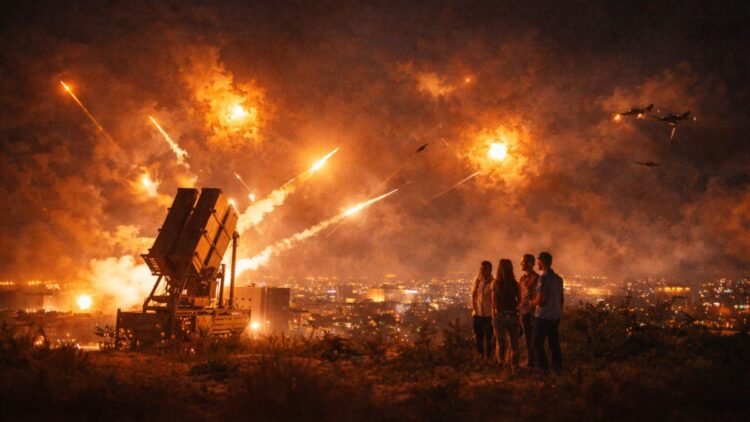
The Middle East conflict entered its sixth day with the fighting widening on multiple fronts: fresh Israeli strikes hit Tehran and Beirut, Iran kept up missile and drone attacks across the region, and the United States signaled it intends to sustain the campaign rather than narrow it. Israeli and U.S. operations have now hit thousands of targets in Iran, while Gulf states and Israel continue intercepting incoming Iranian projectiles.
Reuters reported that the U.S. says it is not expanding its formal military objectives, but Defense Secretary Pete Hegseth also said the campaign can be sustained “as long as we need to.”
What happened on Day 6

Israel said it had begun a new broad wave of strikes on Tehran, and Iranian state media reported impacts in parts of the capital, including Jomhuri Avenue in earlier strike reporting.
AP said Israeli strikes also hit Tehran and Kermanshah, while Israel expanded attacks into Lebanon after issuing a blanket evacuation order for Beirut’s southern suburbs, an area strongly associated with Hezbollah. AP described the Beirut evacuation order as one that sent civilians into panic and severe traffic congestion before airstrikes followed.
The Lebanon front intensified sharply. AP reported that Israel’s evacuation warning covered nearly all of southern Beirut, an area housing a very large civilian population, and that subsequent strikes deepened fears of a broader regional war.

Ground combat was also reported near the southern Lebanese border, while Hezbollah continued missile attacks and released footage it said showed strikes on Israeli tanks. AP said the conflict in Lebanon has already killed 123 people and displaced more than 83,000.
Iranian retaliation and regional interceptions
Iran’s retaliation is no longer limited to Israel. Reuters reported earlier this week that Iranian missiles and drones had been fired into several Gulf countries, including at regional U.S. bases. Reuters’ latest running counts showed the scale of the barrage: in the UAE, 196 ballistic missiles were detected, 181 intercepted, 13 fell into the sea, and 2 landed on UAE territory; 1,072 drones were detected and 1,001 intercepted. In Qatar, Reuters reported 101 ballistic missiles detected and 98 intercepted, plus 39 drones detected and 24 intercepted.
On Friday, additional interceptions were reported. A live update from Times of India, citing official statements, said Saudi Arabia intercepted three ballistic missiles aimed at Prince Sultan Air Base and Qatar intercepted a drone targeting Al Udeid Air Base.

Because these details came through live reporting and official announcements rather than a full Reuters or AP write-up at the time of checking, they should be treated as fast-moving battlefield claims.
US campaign intensifies
Washington’s military role is growing more visible. AP reported that U.S. forces struck the Iranian drone carrier IRIS Shahid Bagheri and had earlier sunk an Iranian frigate off Sri Lanka.
Reuters reported the joint U.S.-Israeli operation, referred to by U.S. officials as Operation Epic Fury, has hit more than 2,000 targets, including about 30 Iranian warships, and is now shifting toward dismantling Iran’s missile production infrastructure.
President Donald Trump said he has “no time limits” on how long the war could continue, while Hegseth said U.S. objectives remain focused on Iran’s offensive missile capability, missile production sites, and naval assets.
Reuters also reported that six U.S. soldiers were killed in Kuwait in a drone strike, underscoring the growing cost of the conflict for American forces.
Human toll and displacement
The casualty toll keeps rising. AP reported that the war has killed more than 1,230 people in Iran, more than 120 in Lebanon, and over a dozen in Israel. Reuters had earlier cited the Iranian Red Crescent saying Iran’s death toll had reached 787 as of March 3, showing how quickly losses have mounted in just a few days. Civilian displacement is also growing as bombardment spreads in Iran and Lebanon.
Key facts at a glance
| Item | Latest reported figure/details |
|---|---|
| Conflict stage | Day 6 |
| U.S.-Israeli targets hit in Iran | 2,000+ |
| Iranian warships reportedly destroyed | About 30 |
| Iran deaths reported by AP | 1,230+ |
| Lebanon deaths reported by AP | 120+ |
| Lebanon displaced | 83,000+ |
| UAE ballistic missiles detected/intercepted | 196 / 181 |
| Qatar ballistic missiles detected/intercepted | 101 / 98 |
| Saudi interceptions reported Friday | 3 ballistic missiles |
| U.S. soldiers killed in Kuwait | 6 |
Why this matters now
The biggest shift on Day 6 is that the conflict is clearly no longer confined to a direct Israel-Iran exchange. Lebanon is an active front, Gulf states are intercepting incoming fire, U.S. forces are taking casualties, and commercial security concerns around the Gulf continue to grow.
Reuters and AP reporting together suggest a campaign that is broadening geographically even as U.S. officials insist the formal objectives remain limited.
FAQs
Which countries are intercepting Iranian strikes?
Based on the latest reporting reviewed here, interceptions have been reported in the UAE, Qatar, Saudi Arabia, and Israel, with Bahrain also reporting strike impacts.
Is the United States expanding the war?
Reuters reported the Pentagon says the U.S. is not expanding its stated military objectives, but it is intensifying attacks on Iranian missile, naval, and production targets.
How many people have been killed so far?
AP’s latest tally says over 1,230 people in Iran, more than 120 in Lebanon, and over a dozen in Israel have been killed.