
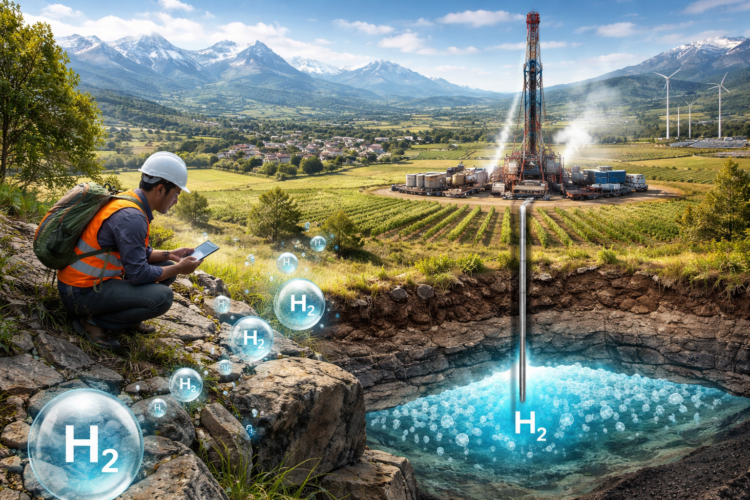
In 2025 and 2026, France’s “white hydrogen” discovery has captured global attention as a potentially transformational energy breakthrough. What began as methane research in old coal basins in Lorraine and Moselle turned into one of the most remarkable energy-related geological discoveries in decades.
This article explores what has actually been found, what remains unproven, and why this matters for the future of clean energy. The story combines scientific reality, economic aspirations, and unresolved questions.
What Is White Hydrogen?

White hydrogen, also known as natural hydrogen, geologic hydrogen, or native hydrogen, refers to hydrogen gas that occurs naturally underground through geological processes rather than being produced industrially. Unlike green hydrogen (produced by electrolysis using renewable electricity), white hydrogen forms when water reacts with iron-rich rocks or through natural geological reactions deep beneath the Earth’s crust. It is pure H₂ gas and near-zero carbon at source.
Comparison: Hydrogen Types
| Hydrogen Type | Source | Carbon Impact | Production Method |
|---|---|---|---|
| White Hydrogen | Naturally occurring underground | Near zero | Extracted from reservoirs |
| Green Hydrogen | Produced industrially | Low (if renewables used) | Electrolysis |
| Grey Hydrogen | Produced from fossil fuels | High | Steam reforming of gas |
What France Has Actually Found
Discovery in Lorraine Basin
In northeast France’s Lorraine region, geological surveys and deep drilling uncovered a massive deposit of white hydrogen beneath old coal mine areas. Initial findings from well data showed unusually high natural hydrogen concentrations at depths around 1,100 to 1,250 meters — far beyond what geologists expected.
Estimated Reserves
Current estimates suggest that the Lorraine discovery could contain up to 46 million tonnes of white hydrogen, making it one of the largest known natural hydrogen deposits anywhere in the world. This deposit is valued in the tens of trillions in economic potential — often reported as up to 92 trillion dollars if all future energy applications are realized.
High Profile Geological Players

The research has been led by teams from the GeoRessources Laboratory and France’s National Centre for Scientific Research (CNRS), notably Philippe de Donato and Jacques Pironon, who were initially drilling for methane. Their investigations unveiled a significant hydrogen signal instead.
Exploration Permits and Policy Actions
France amended its mining code in 2022 to include natural hydrogen as a mineral resource. Since then, several exploration permits have been granted, including one near the Pyrenees-Atlantiques in late 2023, initiating early seismic surveys and drilling projects.
What Still Isn’t Proven
Commercial Extractability
While the presence of millions of tonnes of hydrogen is promising, no large-scale commercial extraction method has yet been demonstrated. Only one natural hydrogen project in Mali currently supplies electricity to a village. France’s discoveries remain exploratory.

Determining how much of the hydrogen can be economically and sustainably extracted at industrial scale remains a major unknown. Some estimates suggest huge reserves, but only a portion may be technically recoverable with current technology.
Economic Viability
Although projections suggest that white hydrogen could be produced at costs perhaps less than $1/kg, real-world field data are still lacking. The costs associated with deep drilling, reservoir management, infrastructure development, and safety monitoring may significantly affect viability.
Geological Regeneration
A highly debated question is whether these hydrogen reservoirs could sustain continuous production over decades or centuries. Some scientists posit that hydrogen may be regenerated through rock-water interactions, but solid evidence for such self-replenishment is limited.
Environmental Impacts of Extraction
How white hydrogen extraction affects groundwater, seismic stability, and ecosystems is largely unknown. While white hydrogen is zero-carbon at combustion, subsurface ecological risks and industrial impacts must be thoroughly studied before large-scale deployment.
Why This Matters
Decarbonization and Climate Goals
Global demand for low-carbon energy is rising rapidly. Hydrogen — whether green, blue, or white — is seen as essential in decarbonizing heavy industry, aviation, shipping, and energy storage. A naturally occurring, low-carbon hydrogen resource could transform energy systems and facilitate climate goals more cheaply than manufactured hydrogen sources.
Strategic Energy Independence
For France and Europe, developing domestic natural hydrogen supplies could reduce reliance on imported fossil fuels and hydrogen feedstocks, bolstering energy security and strategic autonomy in a geopolitically volatile era.
Industrial Growth and Job Creation
The development of white hydrogen could spur hundreds to thousands of jobs, new manufacturing and service sectors, research initiatives, and regional economic revitalization — especially in traditional industrial bases like Lorraine.
Global Hydrogen Market Dynamics
If white hydrogen proves commercially viable, it may reshape global hydrogen markets by adding a new low-cost source, affecting pricing, investment patterns, and infrastructure planning.
Conclusion
France’s white hydrogen discovery represents a significant milestone in the energy transition narrative. It offers the potential for abundant, low-carbon energy that could accelerate decarbonization, enhance energy security, and spark industrial transformation.
However, many questions about commercial feasibility, sustainable extraction, and environmental impacts remain unresolved. As exploration continues and technologies mature, the world may be on the brink of a new era in clean energy — one that could hinge on the “white gold” beneath our feet.
FAQs
What is white hydrogen?
White hydrogen is naturally occurring molecular hydrogen found deep underground, formed by geological processes rather than manufactured industrially.
How much white hydrogen has France discovered?
Geological surveys estimate around 46 million tonnes in the Lorraine/Moselle basin — one of the largest known occurrences.
Will white hydrogen replace fossil fuels?
While not a complete replacement, white hydrogen could play a major role in clean energy systems, especially where electrification is challenging.