


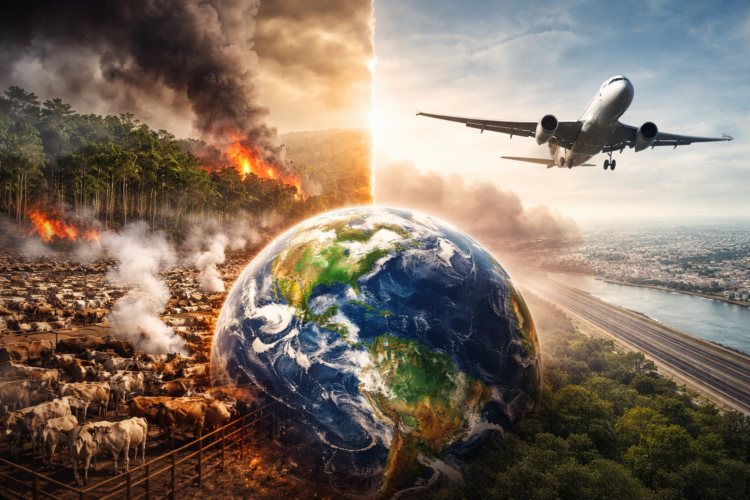
Meat Eaters Are Worse For The Planet Than Frequent Flyers. The debate over climate responsibility often focuses on air travel. Frequent flyers are regularly criticized for their carbon footprint. However, growing scientific evidence suggests that daily dietary choices—especially heavy meat consumption—may have a far greater environmental impact than flying.
Research on global emissions shows that animal agriculture contributes significantly more greenhouse gases than the aviation industry, raising an uncomfortable question: are meat eaters actually worse for the planet than frequent flyers?


This article explores the data behind food emissions, livestock farming, land use, methane production, and aviation pollution to understand the true climate impact of meat consumption.
Global Emissions: Food Production Vs Aviation
One of the most striking climate comparisons is the difference between food system emissions and aviation emissions.
- Food production accounts for roughly 26% of global greenhouse gas emissions.
- Livestock alone contributes around 12–14.5% of global emissions, with some estimates going as high as 20%.
- Aviation contributes about 2.5% of global CO₂ emissions.
This means livestock emissions are several times larger than aviation emissions globally.
Key Emissions Comparison
| Sector | Share of Global Greenhouse Gas Emissions | Main Sources |
|---|---|---|
| Livestock & Animal Agriculture | 12% – 20% | Methane from cattle digestion, manure, feed production, deforestation |
| Total Food System | ~26% | Agriculture, land use change, fertilizers, livestock |
| Aviation | ~2.5% | Jet fuel combustion and high-altitude emissions |
| Agriculture Sector Overall | ~11–12% | Livestock methane, soil emissions, fertilizer use |

The numbers reveal that reducing meat consumption could have a much larger climate benefit than reducing flights alone.
Why Meat Has Such A Large Carbon Footprint
Methane From Livestock
A major reason meat production impacts the climate is methane emissions. Cattle, sheep, and goats produce methane during digestion through a process called enteric fermentation. Methane is a powerful greenhouse gas with a warming potential far greater than carbon dioxide over short time periods.
Livestock farming is responsible for about 32% of global methane emissions, making it one of the largest contributors to climate warming.
Land Use And Deforestation

Another critical issue is the massive land required for livestock production.
- Half of the world’s habitable land is used for agriculture.
- Three-quarters of agricultural land is used for livestock grazing or growing feed crops.
Despite using such vast land resources, meat and dairy provide only a small portion of global calories compared to plant foods. Deforestation to create pasture and grow feed crops releases enormous amounts of carbon dioxide, making livestock production one of the largest drivers of ecosystem destruction.
Meat Production Vs Air Travel: Individual Impact
While aviation has a visible carbon footprint, meat consumption happens daily, which dramatically increases its cumulative impact.
For example:
- A long-haul round-trip flight may emit roughly 1–2 tons of CO₂ per passenger.
- But a high-meat diet can produce similar or higher emissions annually due to repeated consumption of beef and dairy.
Studies show that switching from beef to plant-based proteins can reduce meal emissions by more than 90% Even replacing beef with chicken can cut emissions roughly in half. This means diet changes often provide faster climate benefits than limiting occasional flights.
Environmental Impacts Beyond Carbon
Meat production harms the environment in ways that aviation does not.
Water Use
Agriculture consumes around 70% of global freshwater withdrawals, much of it for livestock and feed crops. Producing beef requires thousands of liters of water per kilogram of meat.
Biodiversity Loss
Livestock farming is a major driver of habitat destruction. Large areas of rainforest and natural ecosystems are cleared to create grazing land, which reduces biodiversity and accelerates climate change.
Pollution
Livestock waste produces ammonia and nitrogen pollution, damaging air quality and waterways.
These pollutants contribute to:
- toxic algal blooms
- soil degradation
- public health problems
The Future Climate Impact Of Meat Consumption
Global demand for meat continues to rise. Over the past two decades, global meat production has increased by nearly 40%, contributing to rising agricultural emissions.
At the same time:
- global population is growing
- incomes are increasing in developing countries
- meat consumption is expanding rapidly
If current trends continue, livestock emissions could become one of the largest barriers to meeting global climate targets.
Can Dietary Change Solve Part Of The Climate Crisis?
Experts increasingly argue that dietary change is one of the fastest ways to reduce global emissions. A global shift toward plant-based diets could cut food-related greenhouse gas emissions by up to 49%, while freeing massive amounts of land for natural ecosystems. Even moderate reductions in meat consumption could significantly lower environmental impact.
Possible climate-friendly dietary strategies include:
- reducing beef and lamb consumption
- increasing plant-based proteins
- supporting sustainable farming practices
- reducing food waste
Why This Conversation Is So Controversial
Comparing meat consumption with flying can be uncomfortable because diet is personal and cultural. Frequent flyers are easy targets for climate criticism because air travel is visible and associated with luxury lifestyles. However, daily dietary habits can create far greater cumulative emissions than occasional flights, making the climate impact harder to ignore. This is why many climate scientists say dietary choices must become part of climate discussions.
Conclusion
The idea that frequent flyers are the biggest climate offenders is increasingly challenged by climate science. While aviation does contribute to global warming, the data shows that animal agriculture—especially meat consumption—produces far greater greenhouse gas emissions. Livestock farming drives methane emissions, deforestation, water consumption, and biodiversity loss on a global scale.
Acknowledging this reality does not mean eliminating meat entirely, but it does mean recognizing that diet is one of the most powerful tools individuals have to reduce their environmental impact.As climate awareness grows, the conversation is shifting: what we eat may matter even more than how often we fly.
FAQs
1. Is Eating Meat Really Worse Than Flying For The Climate?
Yes, globally livestock emissions are several times higher than aviation emissions, meaning heavy meat consumption can have a larger climate impact overall.
2. Which Meat Has The Highest Environmental Impact?
Beef and lamb have the highest carbon footprint because cattle and sheep produce large amounts of methane during digestion.
3. Do You Need To Become Vegetarian To Help The Climate?
No. Even reducing meat consumption—especially beef—can significantly lower your personal carbon footprint.