


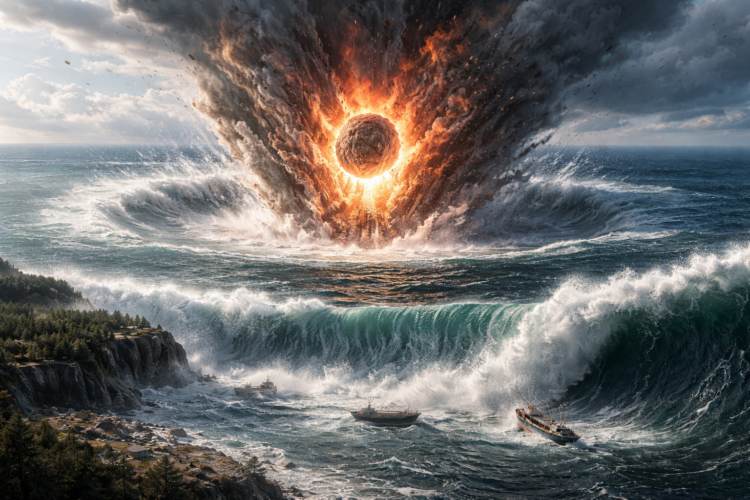
A groundbreaking scientific discovery has revealed that a massive asteroid impact in the North Sea triggered an enormous 330-foot tsunami, reshaping parts of ancient Europe millions of years ago. For decades, scientists debated the origin of a mysterious underwater structure known as the Silverpit Crater, but recent research has confirmed that it was created by a space rock collision with Earth.
This impact event occurred approximately 43 to 46 million years ago, when a 160-meter-wide asteroid slammed into the shallow seabed of the North Sea. The collision produced a powerful explosion, sending massive waves across nearby coastlines and leaving behind a large crater buried deep beneath the ocean floor.


Although the event occurred long before humans existed, the findings help scientists understand asteroid hazards, planetary history, and potential future risks from space objects.
Key Information About The North Sea Asteroid Impact
| Category | Details |
|---|---|
| Event | Ancient asteroid impact |
| Location | North Sea near the United Kingdom |
| Estimated Age | 43–46 million years |
| Asteroid Size | About 160 meters (approx. football-field length) |
| Resulting Tsunami | Around 100 meters (330 feet) high |
| Crater Name | Silverpit Crater |
| Crater Depth | About 700 meters beneath seabed |
| Distance From Coast | Approximately 80 miles off Yorkshire |
| Research Lead | Scientists from Heriot-Watt University |
| Research Methods | Seismic imaging, rock analysis, computer modeling |
The Discovery Of The Silverpit Crater
The Silverpit Crater lies hidden beneath layers of sediment in the southern North Sea, roughly 80 miles off the coast of Yorkshire in the United Kingdom. Scientists discovered this geological structure in 2002 during petroleum exploration, but its origin remained controversial for years.
Some experts believed it formed due to salt movement beneath the seabed, while others suspected an asteroid impact. The debate continued for more than two decades until advanced research techniques provided clear evidence.

Recent studies used:
- High-resolution seismic imaging
- Microscopic analysis of rock fragments
- Computer modeling of impact dynamics
These analyses revealed the presence of shocked minerals, a distinctive signature produced only by high-energy asteroid collisions. This confirmed that the Silverpit structure is indeed an impact crater formed by a cosmic object striking Earth. The crater measures roughly 2 miles (3.2 kilometers) in diameter and is surrounded by circular geological faults formed during the impact explosion.
How The Asteroid Impact Created A 330-Foot Tsunami
When the asteroid crashed into the shallow waters of the North Sea, it struck with extreme speed and energy. Scientists estimate that the collision instantly vaporized seawater and rock, blasting a huge column of debris high into the atmosphere.

The impact triggered several dramatic events:
- Seabed Explosion
The asteroid punched through the seabed, excavating a large crater and ejecting massive amounts of sediment. - Water Displacement
The sudden displacement of seawater generated enormous waves. - Mega-Tsunami Formation
Computer simulations suggest that the impact produced a tsunami over 100 meters (330 feet) tall. - Wave Propagation Across Europe
The massive waves likely spread across large areas of the North Sea basin, affecting nearby coastlines and marine ecosystems.
The height of the tsunami would have been comparable to a 30-story building, making it one of the largest known ancient ocean waves generated by an asteroid impact.
Geological Evidence Supporting The Impact
Scientists gathered multiple lines of evidence confirming the asteroid origin of the crater:
1. Shocked Minerals
Microscopic rock fragments contained shocked quartz, a mineral deformation produced only under extreme pressure from impacts.
2. Crater Structure
The Silverpit crater displays classic impact features, including:
- Circular shape
- Central peak
- Concentric faults surrounding the crater
3. Seismic Imaging
Detailed seismic scans of subsurface layers revealed deformation patterns consistent with high-velocity asteroid collisions rather than salt movement.
These findings confirmed that the North Sea crater belongs to the rare group of oceanic asteroid impact sites on Earth.
Why This Discovery Matters Today
Although the asteroid struck Earth millions of years ago, the discovery has major implications for modern science.
Understanding Planetary History
The event shows how cosmic impacts have shaped Earth’s surface throughout geological history.
Improving Asteroid Impact Models
Studying this crater helps scientists refine models that predict tsunami formation after ocean impacts.
Future Planetary Defense
The research also emphasizes the importance of tracking near-Earth objects that could potentially threaten our planet.
Scientists estimate that large asteroid impacts occur relatively rarely, but even smaller impacts in the ocean could generate significant tsunamis.
Comparison With Other Major Asteroid Impacts
The North Sea impact was powerful but far smaller than some other asteroid events.
For example, the Chicxulub asteroid, which struck Earth about 66 million years ago, was around 10 kilometers wide and caused a mass extinction that wiped out about 75% of life on Earth, including the dinosaurs.
Compared with that global catastrophe, the Silverpit event was regional in scale, yet still powerful enough to generate enormous waves.
Future Research And Scientific Importance
Researchers believe that further studies of the Silverpit crater and surrounding sediments could reveal additional details about the impact event.
Future investigations may focus on:
- Mapping the full tsunami deposits across Europe
- Determining the exact energy of the asteroid collision
- Studying the effects on ancient marine ecosystems
- Identifying similar hidden craters in other oceans
The discovery also highlights the possibility that many ancient asteroid impacts remain undiscovered beneath oceans or sediment layers.
Conclusion
The confirmation that a massive asteroid struck the North Sea and generated a 330-foot tsunami provides a fascinating glimpse into Earth’s violent geological past. The discovery of the Silverpit impact crater resolves a long-standing scientific debate and demonstrates how cosmic collisions have shaped our planet’s landscape.
Although the event occurred tens of millions of years ago, its study is crucial for understanding asteroid hazards, tsunami generation, and planetary defense strategies. As researchers continue exploring Earth’s oceans and geological records, more hidden evidence of ancient cosmic impacts may soon emerge, offering deeper insights into the dynamic history of our planet.
FAQs
When did the asteroid hit the North Sea?
The asteroid impact occurred approximately 43 to 46 million years ago, long before humans evolved.
How large was the asteroid?
Scientists estimate the asteroid was about 160 meters wide, roughly the size of a football field.
How big was the tsunami created by the impact?
The collision generated a tsunami approximately 100 meters (330 feet) high, capable of spreading across large parts of the North Sea.