
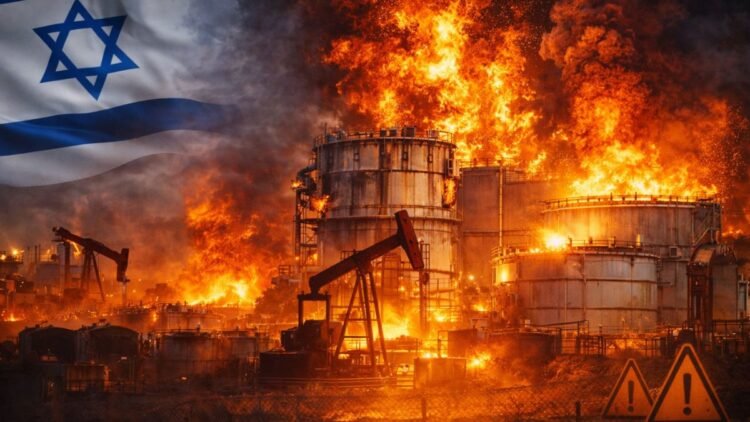
Tensions in the Middle East have intensified after Israeli airstrikes targeted key energy infrastructure in Tehran, prompting Iran to threaten retaliation against oil facilities across the Gulf region. The attacks have raised global concerns about potential disruptions to energy supplies and a broader regional conflict that could affect the world economy.
The situation escalated dramatically after several explosions and fires were reported at oil storage sites near the Iranian capital, sending thick black smoke across parts of Tehran and sparking warnings from Iranian military officials.
Israeli Airstrikes Hit Iranian Energy Infrastructure

According to Iranian officials, Israeli strikes hit at least five energy-related facilities in and around Tehran, including four fuel storage depots. The explosions triggered large fireballs and thick smoke that lingered across the capital for hours.
Iran’s national oil distribution company confirmed that four employees were killed in the attacks. Witnesses in Tehran reported a strong smell of burning oil spreading throughout the city, while explosions in the nearby city of Karaj were heard across the surrounding areas.
The strikes marked one of the most serious attacks on Iran’s energy infrastructure in recent years.
Iran Issues Warning Over Global Oil Prices

Following the attacks, Iran’s Islamic Revolutionary Guard Corps (IRGC) issued a warning that continued strikes on Iranian oil facilities could trigger retaliation against energy infrastructure across the Gulf.
A spokesperson for the IRGC warned that the conflict could severely impact global energy markets.
“If you can tolerate oil at more than $200 per barrel, continue this game,” the spokesperson said, suggesting that oil facilities in neighboring countries could become targets if the conflict escalates further.

Such a disruption could significantly affect the global economy, as the Gulf region is responsible for a large share of the world’s oil production.
US Attempts to Calm Energy Markets
The United States has attempted to calm rising concerns about global oil supplies. US Energy Secretary Chris Wright stated that Washington does not plan to target Iran’s energy infrastructure.
He indicated that the recent strikes were carried out by Israel and suggested that any disruption to oil and gas supplies would likely be temporary.
Wright said global energy markets might experience disruption for only a few weeks in a worst-case scenario.
Iran currently produces roughly 4% of global oil supply, much of which is exported to China, making stability in the region critical for international energy markets.
Iran Announces New Supreme Leader
The military escalation coincides with a major political development inside Iran. On Sunday, Iran announced that Mojtaba Khamenei, the second son of the late supreme leader Ayatollah Ali Khamenei, had been selected as the country’s new supreme leader.
Members of the clerical assembly responsible for selecting Iran’s highest authority described the decision as a “decisive vote.”
Officials called on citizens across the country to support the new leadership and maintain unity during a critical moment for the nation.
The appointment is historic because it marks the first time since the 1979 Islamic Revolution that Iran’s supreme leadership has passed directly from father to son. This development has sparked debate within Iran about the emergence of a dynastic political system.
Conflict Spreads Across the Gulf
As tensions increased, Iran launched a new wave of strikes targeting several Gulf states, raising fears of a wider regional war.
Countries reporting attacks included:
- Saudi Arabia
- United Arab Emirates
- Qatar
- Bahrain
- Kuwait
Saudi Arabia reported intercepting 15 drones, while Bahrain said a strike caused material damage to a desalination plant.
In Saudi Arabia’s city of Al-Kharj, a projectile hit a residential area, killing two people and injuring 12 others.
Israel and Iran Continue Exchanging Attacks
Iran also launched ballistic missile strikes toward Tel Aviv and central Israel. Most of the missiles were intercepted by Israeli air defenses, though at least one person was seriously injured after a residential building was struck.
At the same time, Israel expanded military operations against Iranian-backed groups across the region. Airstrikes in Lebanon, where the militant group Hezbollah is based, resulted in significant casualties.
An Israeli strike on a hotel in Beirut killed four people, while additional attacks in southern Lebanon killed 12 others. Israeli officials said the targets included key commanders linked to Iran’s Quds Force.
Humanitarian Crisis Deepens
The growing conflict has caused significant humanitarian damage. In Lebanon alone, officials say at least 394 people have been killed, while humanitarian organizations estimate around 300,000 people have been displaced.
Violence has also increased in the West Bank and Gaza, where clashes between Israeli forces and Palestinian groups continue.
An Israeli airstrike in Gaza City killed two Palestinians, according to local health officials.
Global Concerns Over Wider War
The ongoing exchange of strikes between Israel and Iran has raised concerns that the conflict could escalate into a broader regional war.
If attacks on Gulf oil infrastructure occur, global energy markets could face severe disruptions. Analysts warn that oil prices could spike dramatically if major production or export facilities are targeted.
With military operations spreading across several countries and political tensions rising, global leaders are closely monitoring the situation as fears grow of a wider Middle East conflict.
FAQs
Why did Iran threaten Gulf oil facilities?
Iran warned of retaliation after Israeli airstrikes targeted energy sites near Tehran.
Could the conflict affect oil prices?
Yes, disruptions to Gulf oil facilities could push global oil prices significantly higher.
Which countries reported recent attacks?
Saudi Arabia, UAE, Qatar, Bahrain and Kuwait reported drone or missile incidents.