
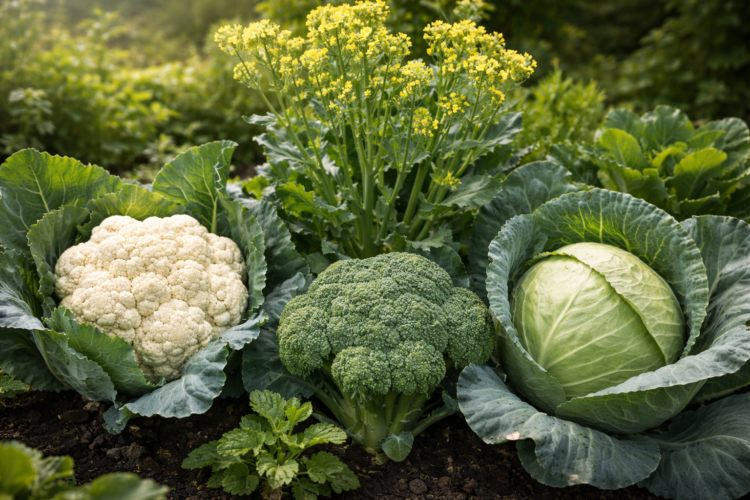
Many people assume cauliflower, broccoli, and cabbage are completely different vegetables. However, botanically they are all varieties of the same plant species called Brassica oleracea. Through centuries of selective breeding, farmers and scientists transformed one wild plant into several vegetables with different shapes, textures, and flavors.
This fascinating relationship shows how human agriculture and genetics can shape food crops over time. Today, these vegetables are among the most widely consumed cruciferous vegetables in the world and play a major role in global nutrition and agriculture.
What Is Brassica Oleracea?

Brassica oleracea is a plant species in the Brassicaceae family, also known as the mustard or cabbage family. The wild ancestor, often called wild cabbage, originally grew along rocky coastlines of the Mediterranean region in southern and western Europe.
Wild cabbage had thick leaves that helped it survive salty winds and harsh coastal environments. Over thousands of years, farmers cultivated this plant and selectively bred it to emphasize different edible parts such as leaves, stems, buds, or flowers.
As a result, many vegetables we eat today evolved from the same species, including:
- Cabbage
- Broccoli
- Cauliflower
- Kale
- Brussels sprouts
- Kohlrabi

Even though these vegetables look completely different, genetically they belong to the same plant species.
How One Plant Became Many Vegetables
The reason these vegetables look different is due to selective breeding, a process where farmers repeatedly choose plants with desirable traits and grow them over many generations.
Different parts of Brassica oleracea were enhanced through breeding:
- Cabbage – bred for large leafy heads
- Broccoli – bred for large flowering buds
- Cauliflower – bred for dense flower clusters
- Kohlrabi – bred for thick stems
- Brussels sprouts – bred for small leafy buds along the stem

These changes happened gradually over centuries, transforming a single wild plant into a wide range of vegetables used worldwide.
Key Facts About Cauliflower, Broccoli, And Cabbage
| Vegetable | Scientific Name | Edible Part | Key Nutrients | Unique Feature |
|---|---|---|---|---|
| Cauliflower | Brassica oleracea var. botrytis | Flower clusters | Vitamin C, Vitamin K | Compact white curd formed by undeveloped flower buds |
| Broccoli | Brassica oleracea var. italica | Flower heads and stems | Vitamin C, Vitamin K, fiber | Tree-like structure of green florets |
| Cabbage | Brassica oleracea var. capitata | Leaves | Vitamin C, fiber | Dense leafy head |
Cauliflower is actually a highly modified form of cabbage where the edible portion is made of partially developed flower structures. Broccoli contains large clusters of flower buds attached to a thick stalk and is rich in antioxidants such as sulforaphane.
Nutrition And Health Benefits
All vegetables from Brassica oleracea are considered nutritional powerhouses. They contain important bioactive compounds such as glucosinolates, antioxidants that support human health.
For example:
- 100 grams of Brassica vegetables can provide the recommended daily intake of about 40 mg of vitamin C.
- Broccoli is extremely rich in vitamin C (99% of daily value) and vitamin K (85% DV).
- Cauliflower provides 54% of the daily value of vitamin C per 100 grams.
These vegetables are also linked with potential health benefits such as:
- Reduced risk of chronic diseases
- Improved digestion due to fiber
- Antioxidant protection
- Support for immune health
Because they are low in calories but rich in nutrients, they are often recommended in healthy diets worldwide.
Global Production And Demand
Vegetables from the Brassica family are extremely important in global agriculture.
Some key statistics include:
- Global production of broccoli and cauliflower reached about 26.5–27 million tonnes in recent years.
- China and India together produce around 72–73% of the global supply of these vegetables.
- Worldwide production of cruciferous crops such as cabbage exceeded 72 million tons in 2022.
- China alone produces over 35 million tonnes of cabbage annually, making it the world’s largest producer.
The global market for cabbage and other brassicas is estimated to be worth around USD 36 billion, driven by rising health awareness and demand for nutrient-rich foods.
Future Of Brassica Vegetables
Research into Brassica genetics and breeding is expanding rapidly. In 2024, scientists analyzed more than 700 genetic sequences of Brassica oleracea, helping researchers understand how different vegetable forms evolved from the same plant.
Future developments may include:
- More nutrient-rich varieties
- Climate-resistant crops
- Higher yield through improved genetics
- Sustainable farming techniques
With increasing interest in plant-based diets and functional foods, vegetables like broccoli, cabbage, and cauliflower are expected to remain essential crops in global agriculture.
Conclusion
Cauliflower, broccoli, and cabbage may appear to be completely different vegetables, but they are actually members of the same species, Brassica oleracea. Over thousands of years, selective breeding transformed one wild coastal plant into a diverse family of nutritious vegetables.
Today, these crops feed millions of people worldwide and play a major role in global agriculture and healthy diets. With advances in plant science and sustainable farming, the future of these versatile vegetables looks even more promising.
FAQs
Are cauliflower, broccoli, and cabbage really the same plant?
Yes. They are different cultivated varieties of the same species called Brassica oleracea.
Why do these vegetables look so different?
They look different because farmers selectively bred the plant for different edible parts such as leaves, flowers, or stems.
Are these vegetables healthy?
Yes. They are rich in vitamin C, fiber, antioxidants, and glucosinolates, which support overall health and may reduce disease risk.