
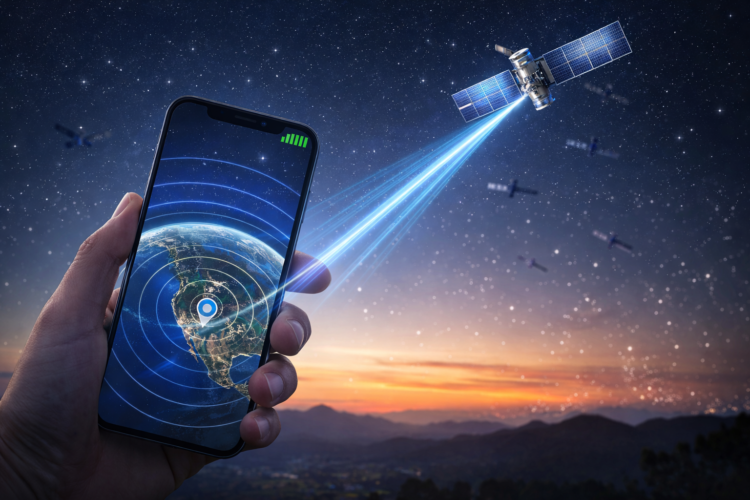
The idea of connecting mobile phones directly to satellites once required specialized satellite handsets. However, new technology called Starlink Direct-to-Cell is changing that reality. Developed by SpaceX, this innovation allows ordinary smartphones to connect to satellites in orbit, extending mobile coverage to remote regions where traditional cell towers cannot reach.
The goal of this system is to eliminate “dead zones” by providing supplemental cellular coverage from space. Instead of relying entirely on terrestrial infrastructure, the system enables phones to communicate with low-Earth-orbit satellites acting like mobile towers in space.

This article explains what satellite direct-to-cell technology means, how it works, what coverage actually looks like in real life, and what the future of mobile connectivity may look like.
What Is Starlink Direct-to-Cell Technology?
Starlink Direct-to-Cell (D2C) is a satellite communication system that allows regular smartphones to connect directly to orbiting satellites without requiring any extra equipment.
Instead of needing a satellite dish or specialized handset, the technology integrates a cellular base-station modem inside Starlink satellites, enabling them to function like cell towers in space. This means a smartphone can automatically switch from terrestrial cellular networks to satellite connectivity whenever it moves outside traditional coverage areas.
Key Characteristics
- Works with existing LTE smartphones
- No external antennas or hardware required
- Uses the same cellular spectrum as mobile carriers
- Automatically activates when normal coverage disappears

The system is designed primarily as backup coverage, ensuring people remain connected in remote areas such as mountains, deserts, oceans, or rural regions.
How Satellite Direct-to-Cell Works
The technology combines low-Earth-orbit satellite networks with traditional mobile networks.
Step-by-Step Process
- Satellite In Orbit
Starlink satellites equipped with cellular antennas orbit Earth at roughly 500–600 km altitude. - Smartphone Connection
When a phone loses ground-based coverage, it attempts to connect to the satellite using the same cellular radio. - Space-Based Cell Tower
The satellite acts as a space-based cellular base station, receiving the signal. - Data Relay
The signal is transmitted through Starlink’s satellite network and ground stations to the internet or telecom network. - Return Communication
The response travels back through the satellite to the smartphone.
This process allows users to send messages, access limited data services, and eventually make calls even in remote regions.
What Coverage Looks Like in Practice

One of the most significant advantages of Starlink direct-to-cell connectivity is the ability to extend mobile coverage into areas previously unreachable.
Instead of building thousands of cell towers, satellites provide blanket coverage across entire countries or oceans.
For example:
- Satellite messaging services began rolling out in 2025 in the United States and New Zealand through telecom partnerships.
- Mobile carriers around the world are testing similar services to expand coverage in rural areas.
However, the coverage is not identical to traditional cellular service.
Real-World Coverage Conditions
- Works best outdoors with a clear view of the sky
- Buildings, mountains, or dense forests may block signals
- Speeds are lower than regular 4G or 5G networks
- Service may start with text messaging before full data support
Despite these limitations, the system dramatically improves connectivity for remote environments.
Features and Technical Capabilities
| Feature | Details |
|---|---|
| Technology | Starlink Direct-to-Cell satellite network |
| Satellite Type | Low-Earth-Orbit (LEO) satellites |
| Hardware Required | None beyond compatible smartphone |
| Early Services | SMS messaging and emergency alerts |
| Future Services | Voice calls and mobile data |
| Network Integration | Works with partner mobile carriers |
| Coverage Area | Remote regions, oceans, rural zones |
| Maximum Estimated Data Capacity | Up to several Mbps per satellite beam in early deployments |
Early research suggests satellite-to-phone data speeds could reach around 4 Mbps per beam, depending on conditions and satellite capacity. Future upgrades may significantly increase throughput.
Supported Smartphones and Devices
One of the most appealing aspects of this technology is compatibility with existing smartphones. Several device models have already been tested with the service.
Examples include:
- iPhone 14 and newer models
- Google Pixel series
- Samsung Galaxy smartphones
- Motorola smartphones
These phones can connect to satellite networks because they already contain cellular radios capable of reaching orbiting satellites when supported by the network. This eliminates the need for specialized satellite phones.
Current Global Deployment
The rollout of direct-to-cell satellite connectivity is occurring through partnerships between Starlink and telecom operators.
Examples include:
- United States – testing through major mobile carriers
- Australia – satellite-to-mobile trials with telecom providers
- Europe – early deployments and pilots
- Ukraine – satellite SMS services for network resilience
In some markets, services initially focus on text messaging and emergency communications, with plans to expand into voice calls and mobile data over the next few years.
Limitations and Challenges
Although satellite mobile connectivity is revolutionary, it still faces technical limitations.
Key Challenges
1. Limited Data Capacity
Satellites cannot currently match the speed or bandwidth of dense 5G tower networks.
2. Signal Obstructions
Buildings, trees, and indoor environments can weaken signals.
3. Network Latency
Although LEO satellites have lower latency than older satellite systems, performance still varies.
4. Regulatory Issues
Spectrum licensing and telecom regulations differ across countries.
Despite these challenges, the technology is expected to improve significantly as more satellites launch.
Future of Satellite-to-Phone Connectivity
The direct-to-cell market is projected to grow dramatically, with industry analysts predicting a multibillion-dollar global sector over the next decade.
By 2027 and beyond, the technology could support:
- Full voice calls
- Mobile data browsing
- Satellite-based emergency communications
- Internet access in remote regions
Next-generation Starlink satellites are expected to offer higher capacity and faster data speeds, potentially enabling near-global smartphone connectivity.
Conclusion
Starlink’s direct-to-cell satellite technology represents one of the most significant advances in telecommunications in decades. By turning satellites into space-based cell towers, it allows everyday smartphones to stay connected even in remote regions where traditional networks fail.
Although early services focus on messaging and limited data, the technology is evolving rapidly. As more satellites launch and mobile carriers adopt the system, the concept of global mobile coverage from space is becoming increasingly realistic.
In the future, satellite connectivity may become a standard feature of smartphones, ensuring that no matter where people travel on Earth, they remain connected.
FAQs
What Is Starlink Direct-to-Cell Technology?
It is a satellite communication system that allows normal smartphones to connect directly to orbiting satellites for messaging, calls, and limited data services.
Do I Need a Special Satellite Phone to Use It?
No. The system is designed to work with existing smartphones using their built-in cellular radios.
Can Satellite-to-Cell Replace Traditional Mobile Networks?
No. It mainly acts as supplemental coverage for areas where terrestrial cell towers are unavailable.